
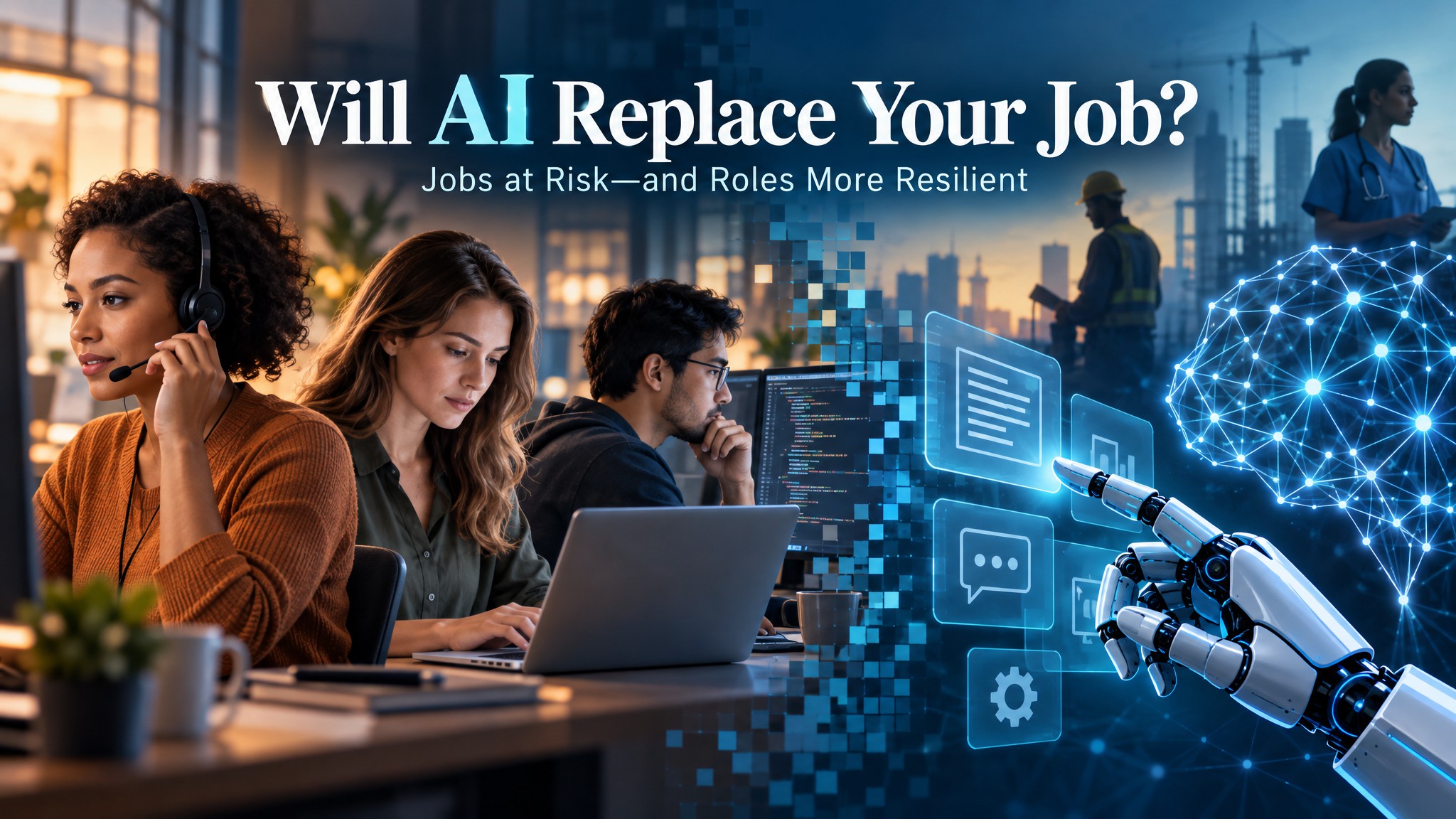
Artificial intelligence has moved past the stage of simple automation. What once seemed limited to factory floors and basic data entry is now reshaping creative industries, white-collar professions, and technical fields. The question is no longer whether AI will affect the workplace, but which roles face the steepest disruption and which remain resilient.
The Roles Under the Most Pressure
Jobs most vulnerable to disruption share common traits: repetitive workflows, structured data processing, formulaic writing, and pattern recognition. When a task follows defined rules, modern AI models can often execute it faster and at significantly lower cost.
Customer Support and Routine Service
Basic tier-one customer service has largely shifted toward AI-driven conversational agents. Modern chatbots resolve routine troubleshooting, process returns, handle order tracking, and manage billing inquiries around the clock. Companies increasingly rely on smaller human teams reserved only for complex or emotionally fraught escalations.
Data Entry, Processing, and Document Review
Roles focused on extracting information from receipts, standardizing spreadsheets, or reading standardized legal documents face shrinking demand. Specialized AI systems can ingest thousands of pages in seconds, cross-check records, and highlight anomalies with high accuracy, compressing workloads that previously required entire teams.
Entry-Level Copywriting, Translation, and Content Aggregation
General web copy, product descriptions, social media captions, and initial language translations are heavily augmented by generative language tools. Content mills and routine writing agencies are trimming junior staff, leaning instead on editors who prompt, correct, and curate AI-generated drafts rather than writing from a blank page.
Basic Software QA and Junior Coding
AI coding assistants write boilerplate code, identify syntax errors, generate unit tests, and translate code between programming languages. This shift raises the bar for entry-level developers. Employers increasingly expect junior programmers to operate at the level of mid-level engineers, focusing on architecture and logic rather than routine scripting.
Junior Financial Analysis and Bookkeeping
Standard financial modeling, ledger balancing, tax preparation for simple returns, and compliance auditing rely heavily on predictable rules. AI can run calculations, reconcile accounts, and flag discrepancies automatically, shifting the analyst’s role from compiling data to interpreting high-level strategy.
Why “Displaced” Does Not Always Mean “Eliminated”
Most roles will not vanish overnight. Instead, the total headcount required to complete a given volume of work decreases. A design department that once required eight junior production artists may need only two or three working alongside image generation software. A law firm that assigned dozens of associates to discovery review can complete the same work with a fraction of the billable hours.
The immediate pressure is felt most acutely at the entry level. As routine entry-level tasks become automated, junior workers have fewer conventional opportunities to build baseline experience, requiring teams to rethink career ladders and apprenticeships.
The Roles Most Resistant to AI
While cognitive tasks of high predictability are vulnerable, other job categories remain difficult or cost-prohibitive for machines to replicate.
Skilled Trades and Physical Manipulation
Electricians, plumbers, heavy equipment operators, welders, and HVAC technicians work in unstructured, physically variable environments. Installing conduit in an older building or repairing an industrial hydraulic line requires dynamic problem-solving and manual dexterity that robotics cannot yet match economically.
High-Touch Healthcare and Therapy
AI can assist in diagnostic imaging and pathology review, but direct patient care requires human presence. Nurses, physical therapists, surgical teams, and mental health counselors rely on bedside empathy, tactile evaluation, and human trust that patients will not accept from a screen.
Strategic Leadership, High-Stakes Negotiation, and Politics
Setting corporate vision, navigating complex labor negotiations, and managing international relations require personal accountability, deep reading of unstated motives, and political intuition. AI cannot assume moral responsibility or shoulder the legal liabilities of executive decision-making.
Complex Engineering and Original Scientific Research
While AI excels at recognizing patterns across existing research, framing novel scientific hypotheses, designing physical laboratory experiments, and debugging novel hardware systems still demand original human insight.
How to Stay Ahead
The workers least likely to struggle in an AI-driven economy are those who treat the technology as leverage rather than competition. Practical steps to build long-term career resilience include:
Developing fluency with relevant AI tools in your discipline, so you can produce at the volume and speed employers will soon expect as standard.
Shifting focus toward domain expertise, judgment, and quality control. Knowing how to evaluate, correct, and verify automated output is becoming more valuable than the manual production of the output itself.
Doubling down on distinctly human skills: complex stakeholder management, clear verbal communication, physical field expertise, and cross-disciplinary problem solving.
The future of work is not a simple contest between humans and machines. It is a rapid transition where professionals who leverage AI will steadily outperform and replace those who do not.